
ARGUS / Combat modeling
Understand what changes the outcome.
A result is only useful when you can explain what produced it. ARGUS connects the question, the model, and the evidence so analysts can examine the consequences of their assumptions.
Inside ARGUS
From an estimate
to its explanation.
Follow an actual ARGUS session using a built-in synthetic scenario. Review the outcome distribution, then examine the explanation and side-by-side model comparison—with each model’s qualifications visible.
Read the walkthrough transcript
A completed forecast is shown in ARGUS using a built-in synthetic scenario and 200 Monte Carlo iterations. The screen displays an outcome distribution, sensitivity indicators, and separate model outputs. The page scrolls to the explanation and Model Council comparison. Each model retains its own qualification: the MDO run is uncalibrated, and the QJM run is marked CHECK. The comparison shows disagreement between calculations on shared synthetic inputs; it is not independent evidence or operational validation.
The question
Which assumptions matter most to this force comparison?
Defense analysts, operations researchers, concept developers, and evaluation teams.
From question
to review.
Frame the comparison
Define the forces, context, time horizon, and outcome of interest. Make the question precise enough to examine.
Examine the estimate
Work through the applicable model and its inputs. Keep assumptions visible alongside the estimate.
Compare alternatives
Change an assumption and inspect how the result moves. Separate a change in evidence from a change in analyst judgment.
Explain the result
Carry the inputs, reasoning, and source record into a reviewable analytical brief.
What to examine
- A defined comparison and its assumptions
- A view of the model and supporting evidence
- An explanation of the differences between alternatives
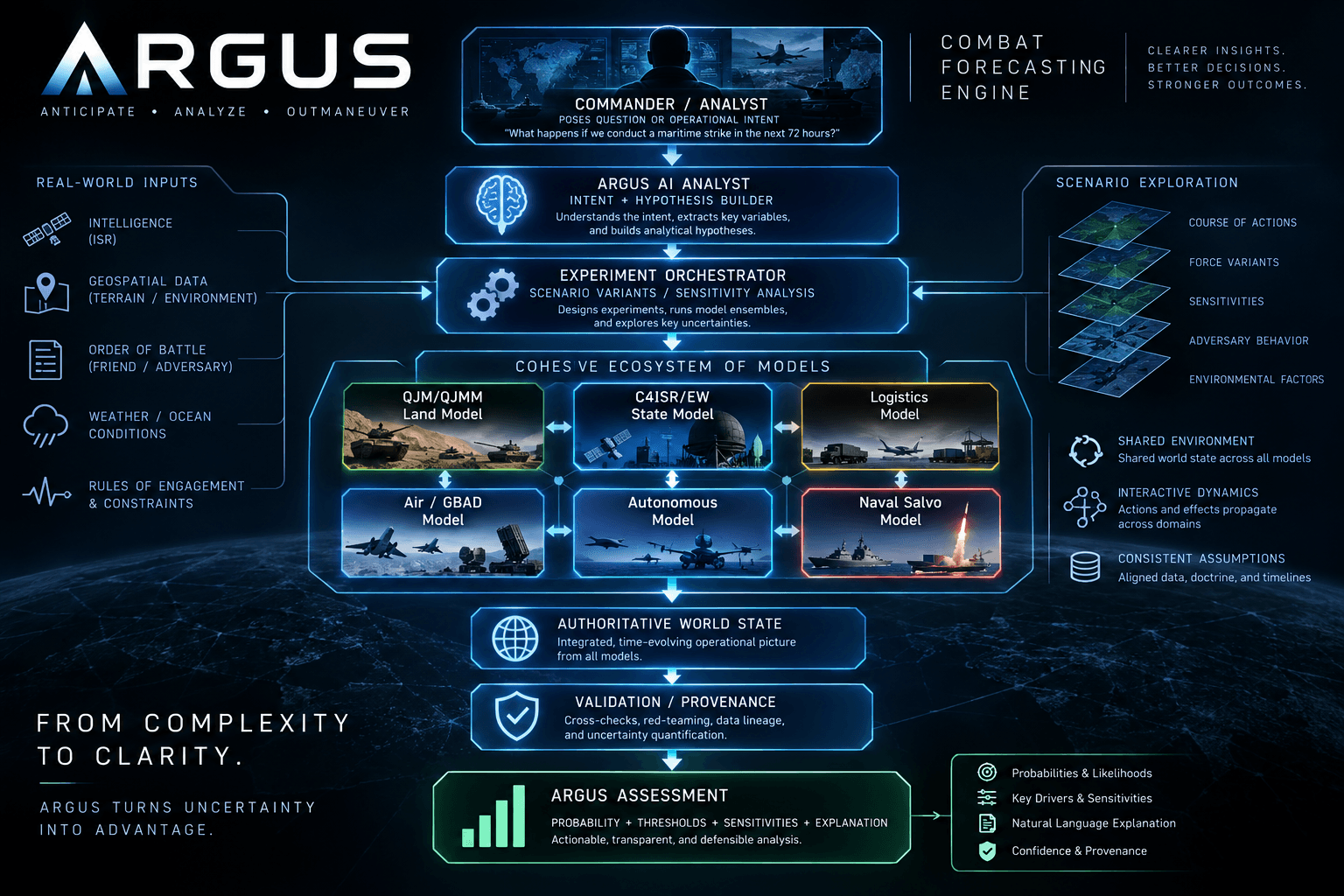
ACE brings land, C4ISR/EW, logistics, air and ground-based air defense, autonomous systems, and the Naval Salvo Model into one architectural view. A demonstration focuses on the models appropriate to your question; a model’s applicability is not established by a diagram alone.
A closer look
Does a combat estimate predict a certain outcome?
No. Estimates depend on the model, inputs, and conditions. ARGUS supports examination of those assumptions and their implications; judgment stays with the analyst.
How does this connect to sustainment?
A force comparison raises the next question: what stocks, replenishment, replacements, and resources would that approach require? ARGUS connects that discussion to logistics and historical evidence.
Bring the question.
Examine it with us.
Tell us what decision you need to support. We will focus the conversation on the relevant workflow, evidence, and outputs.